
Why your business shows up in Shrewsbury but vanishes in Ludlow
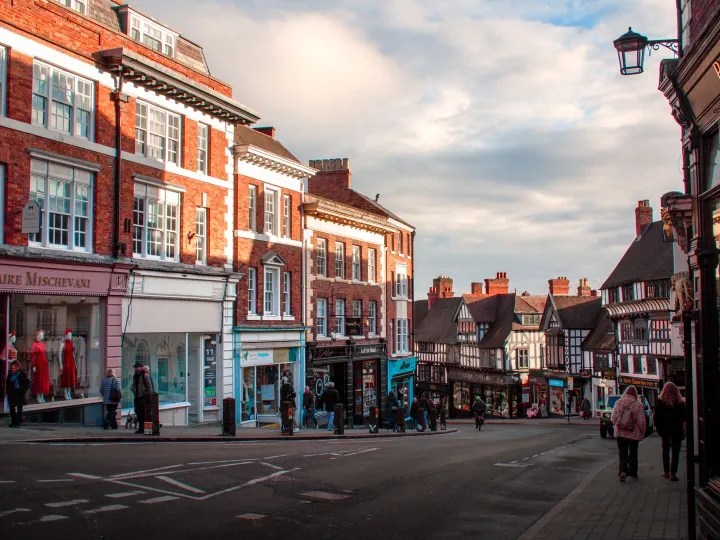
Here is a puzzle that lands in our inbox regularly. A business searches for itself from the office and is delighted. The same business searches from a customer’s kitchen in another town and cannot find itself at all. Something, clearly, has gone wrong.
Nothing has gone wrong. That’s how local search works, and once you know why, a lot of otherwise baffling behaviour makes sense.
Three different sets of results, all wearing the same uniform
When someone searches for a plumber, a florist or a physiotherapist, they usually see three quite separate things stacked on one page. They look like one set of results. They are produced by three different mechanisms, and they respond to completely different efforts.
1. The map results
The box with a map and three businesses in it. This is driven almost entirely by Google Business Profile, and the three things that decide who appears are the profile itself, the reviews, and how close the business is to the person searching.
Your website has remarkably little to do with it. You can have the best website in the county and be absent from the map, and you can have no website at all and sit at the top of it.
2. The ordinary blue links
The normal results underneath. This is where your website does nearly all the work: your pages, your content, how clearly you explain what you do and where you do it.
3. The AI answer at the top
Increasingly there is a summary before either of the above. It is largely assembled from the same two sources, plus directories and review sites. It is not a fourth thing to optimise so much as a mirror held up to the first two, which is oddly reassuring: the work that earns the map results and the blue links is the work that earns a mention there.
Why proximity beats almost everything
The map results are ruthlessly geographical. Google is trying to answer “who is near me”, so the searcher’s location is weighted extraordinarily heavily.
Shropshire makes this vivid. It is one of the largest inland counties in England and one of the most thinly populated, and the distance between market towns is real. A business in Shrewsbury searching from Shrewsbury is standing in the middle of its own strongest signal. The same search from Ludlow, forty minutes south, is a different question with a different correct answer, and Google will answer it with businesses near Ludlow.
That is not a flaw. If you were the person in Ludlow with a burst pipe, it is exactly what you would want.
The practical consequence is worth stating plainly: you cannot win the map results for a town you are not near. No amount of website work will change that, and anyone promising otherwise is selling something.
What you can do instead
Get the profile genuinely right
Most Google Business Profiles are about 60% complete and it costs their owners real money. Worth an hour of anyone’s time:
- Pick the most specific primary category that is true. This is the single most influential setting on the whole profile and people leave it vague.
- Fill in the services or products properly, in the words customers use.
- Set the service area honestly if you travel to customers.
- Add real photographs, and add them occasionally rather than once in 2021.
- Keep the opening hours accurate, including bank holidays.
- Make sure the name, address and phone number match your website exactly, character for character.
Take reviews seriously, in an unglamorous way
Reviews influence the map results more than almost anything else you control. The trick is not a clever system. It is asking at the right moment, which is the moment the job finishes and the customer is pleased, rather than a fortnight later by email.
Reply to all of them. Reply to the bad ones politely and briefly. Anyone reading is judging how you handle the complaint, not whether you ever had one.
Let the website do the job the website can do
This is where the blue links are won. If you genuinely work across a county, you can absolutely earn ordinary results for towns you are not in, because those results care about relevance rather than proximity.
A word of caution, though, and it applies to our own site as much as anybody’s. Ten near-identical pages with the town name swapped are obvious to readers and largely wasted. A page about working in a given town is worth having if it contains something true: the work you have actually done there, the sort of businesses based there, how long it takes you to get there, a photograph of somewhere recognisable. If a page could have any town name dropped into it without changing a word, it probably isn’t earning its place.
We publish pages for Shrewsbury, Ludlow, Telford, Oswestry and the other towns we work in for exactly this reason, and we keep trying to make them say something.
Why service-area businesses behave differently
If you have premises customers visit, such as a shop, a salon or a clinic, your address is your anchor and the map results will favour people near it.
If you travel to customers, you are a service-area business. You can hide your address on your profile, but your registered location still influences where you appear. This catches out mobile businesses constantly: a mobile dog groomer based on the edge of Telford will struggle to appear in the map results in Church Stretton whatever they do, and should be putting their effort into the ordinary results, reviews, and the sort of pages people actually search for.
If you have disappeared entirely
Check, in this order:
- Is the Google Business Profile verified, and has it been suspended? Suspensions are commoner than people realise and often silent.
- Is there a duplicate profile, perhaps created years ago, competing with the real one?
- Has the category changed, or been changed by a well-meaning suggestion from a member of the public?
- Does the address on the profile match the address on your website?
- Are you actually searching from where your customers are, or from the office with your own account signed in? Personal search results are not a measurement.
Two of the five most common causes are nothing to do with your website at all, which is worth knowing before you commission a new one. our piece on websites that quietly stop working covers the rest of that diagnosis.
The short version
The map results are about your profile, your reviews and where you are. The blue links are about your website. The AI summaries mostly reflect both. Work out which one you are missing from before you spend money on anything.
If you would like a hand untangling which of the three is letting you down, get in touch, or read what we do about it on our digital marketing page. And if people are finding you but nothing is happening after that, our plain-English guide to Core Web Vitals is probably the better starting point.
Let's get your website sorted
Tell us about your project – no hard sell, no hidden costs. Just a friendly chat.